In my late twenties, I entered a challenging period of soul searching. At the time I was struggling to understand my place in the world, and the next steps in my life were not materialising. All my ideas felt sterile. Realising my need for support, I met with several therapists.
One of those therapists was memorable because he seemed unusually determined to give my stuckness a clean explanation. I told him about my insecurities, my doubts, and my desire to find congruent forms of expression in work and life. In response, he asked several questions about my parents, my childhood, and even the conditions of my birth. In the space of twenty minutes, he had the answer: my early life was to blame for my current disorientation. There was much work to be done.
I decided not to meet this therapist again. Recognising the one-sidedness of his attitude, my initial reaction was to shrug off our encounter. Yet it left a strong impression on me. While his monomaniacal focus on the past struck me as ill-advised, something in me found it oddly seductive and continues to do so.
Commenting on this seductiveness, C.G. Jung wrote that “no insight into the past and no re-experiencing of pathogenic reminiscences – however powerful it may be – is as effective in freeing man from the grip of the past as the construction of something new.”1
The stalling and stuttering of life can be read as an invitation to undergo initiatory descent. We might need to revisit memories that we locked away in boxes long ago, boxes that now gather dust in the basement. This work of rediscovery can be ugly and unpleasant, but it can also be poignant and profound. As Jung cautions, we can easily get hooked on these experiences, which becomes a defence against living.
Antoine de Saint-Exupéry’s novella The Little Prince gives us an image of this condition. The prince, in his sadness, spends most of his time watching sunsets. Because he lives on a tiny asteroid, he only has to move his chair a few steps whenever he wants to see another sunset. On a particularly sad day, the prince finds himself watching forty-four sunsets.
When we connect with our past, the full spectrum of insights and feelings we uncover might captivate us in all their beautiful complexity. We might become enamoured with our own pensiveness for weeks, months or even years at a time. Like the little prince, we want only the melancholic sunset and not the experience of a new dawn. But we have to keep in view the creative demands of this human life – Jung’s construction of “something new” – which call to us each day.
On the other hand, we must not succumb to unconscious action, the preferred mode of modern culture. This shows up when we declare that “the past is done with”, seeking only to move forward. Don’t look down or back, just up and ahead. Then our actions lack substance, based as they are on naïve ideals rather than weighty, saturnine reflection.
Speaking to this point, Jung goes on: “I am of course very well aware that, without insight into the past and without an integration of significant memories that have been lost, nothing new and viable can be created.”
Invoking Janus
Whenever I feel stuck, I sense the tension in this duality between past-oriented reflection and future-oriented action. The challenge is to sit with not only the symptoms, the mess, and the heaviness of the past, but also the need for vision, direction, and the creation of something “new and viable”.
In dancing this delicate dance, I have come to appreciate the role of soul. Our culture has made little room for soul, even with the rise of psychology, a field which conceptualises itself as the study of the mind.
Thomas Moore says that soul belongs neither to mind nor to body, but is adapted to both. He writes that without soul, “ideas would remain ideas with no connection to the human world”, and that soul “expresses itself in images, dreams, and stories” rather than abstract thought or unconscious action.2 Soul gives body to our ideas and spiritedness to our actions.
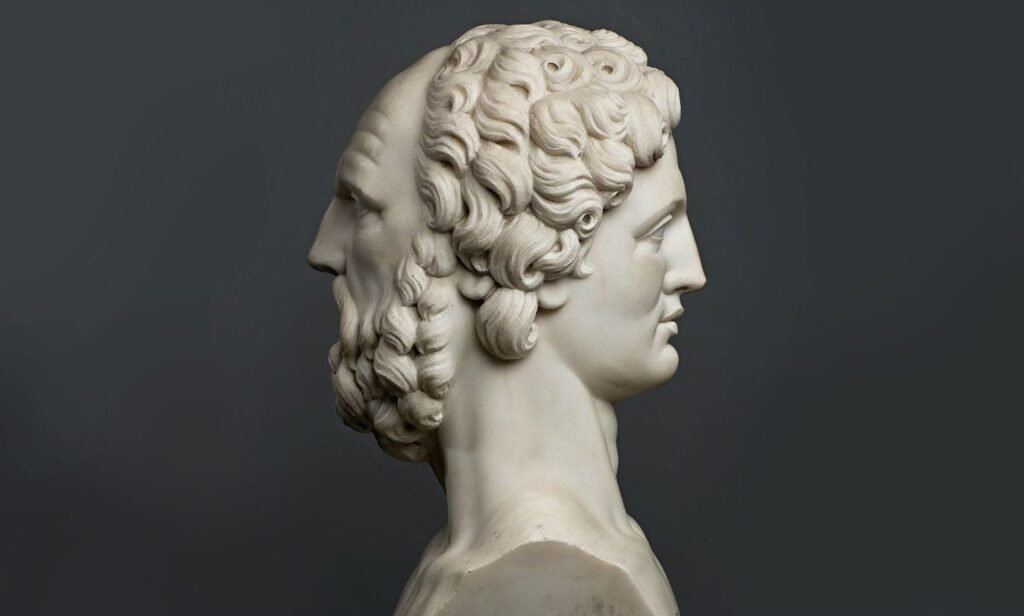
Moore suggests a resonance here with Janus, a favourite image used by Marsilio Ficino in relation to soul. Janus was the Roman God presiding over beginnings and endings, transitions and doorways. He is depicted with two faces looking in opposite directions. The soul, too, is Janus-faced. It beckons us into liminality and fertile ambiguity, where the old dissolves and the new is yet to form.
We might experience something of this in January, which is named after Janus. Perhaps this is why, for many, the first month of the year can be laden with heavy emotions. It is a natural pause in which we find ourselves straddling two worlds; the world of yesterday, with all its loose ends, and the world of tomorrow, that forboding blank canvas.
I’ve found that if I’m open and willing to look, soul is always trying to enter life through the cracks. The glimmers are usually subtle: half-remembered dreams, minor ailments, strange fantasies, subtle coincidences. Whatever the manifestations, I try to let them work on me rather than suffocating them with rational thought or deadening them with premature action.
We are all limited by the past and the vicissitudes of fate. Those very same limitations aim us towards our destiny, everything we must create, and the purposes for which we suffer life on earth. It may be that we can only bridge the two by allowing soul to work its magic.
References
- C.G. Jung, “Freud and Jung: Contrasts”, in Freud and Psychoanalysis, Collected Works Vol. 4.
- Thomas Moore, The Planets Within: The Astrological Psychology of Marsilio Ficino.